Metaphysics
Monkey science goes bananas

Karl Popper - Unended Quest: An Intellectual AutobiographyDarwinism is not a testable scientific theory, but a metaphysical research program.
Michael Ruse - 1993 Annual Meeting of the AAASEvolution, akin to religion, involves making certain a priori or metaphysical assumptions, which at some level cannot be proven empirically.*
The Free Dictionary defines metaphysics asa priori speculation upon questions that are unanswerable to scientific observation, analysis, or experiment.** Wikipedia says that ontology, part of metaphysics,deals with questions concerning what entities exist or may be said to exist and how such entities may be grouped, related within a hierarchy, and subdivided according to similarities and differences.* Metaphysics is part of philosophy. Evolution theory is full of metaphysics. The philosophical foundations of evolution theory are naturalism and uniformitarianism. Evolutionists use similarities and differences in support of their belief, but similarities and differences don't prove anything and might just as well be called evidence for common design.
Homology

Wikipedia - Homology (biology)Evolutionary biology explains homologous structures adapted to different purposes as the result of descent with modification from a common ancestor. ... Charles Darwin explained homologous structures as meaning that the organisms concerned shared a body plan from a common ancestor, and that taxa were branches of a single tree of life.*
Wikipedia - Evidence of common descentThe comparative study of the anatomy of groups of animals shows structural features that are fundamentally similar or homologous, demonstrating phylogenetic and ancestral relationships with other organism, most especially when compared with fossils of ancient extinct organisms.*
Robert J. Richards - Darwin's Metaphysics of MindDarwin ... moved fairly rapidly from considerations of anatomical similarities among animals to cognitive comparisons between animals and man; and so he came to rest the divinity of man on the shoulders of monkeys.
Naturalist Charles Darwin called the origin of species the "mystery of mysteries"** in his book On the Origin of Species, which said absolutely nothing about the "origin" of species. He observed variety within a species and presented an unobservable and speculative theory about how one species supposedly turned into a completely different one based on similarities and differences of this and that.
According to evolutionists similarities and differences supposedly show a relationship between different and unique life forms. The reason why metaphysics is used to support their belief is because science cannot possibly offer direct evidence for a relation between two unique and different life forms, especially over incredible and unobservable timespans based on the unprovable and questionable philosophy uniformitarianism.
Evolutionists try to use the fossil record in support of their metaphysical idea. The preconceived belief in common ancestry and macroevolution makes evolutionists interpret similarities in DNA or physical appearance of unique life forms as evidence for that belief. But it all depends on their worldview. PBS stated in a documentary:the evidence for evolution is all around us, if we choose to look for it.** Evolutionists want evolution to be true and therefore interpret everything as evidence for evolution. They see a similarity of this or that and believe it is caused by evolution, but it's not science, it's philosophy. See also illusory correlation and third-cause fallacy.
Comparative genomics
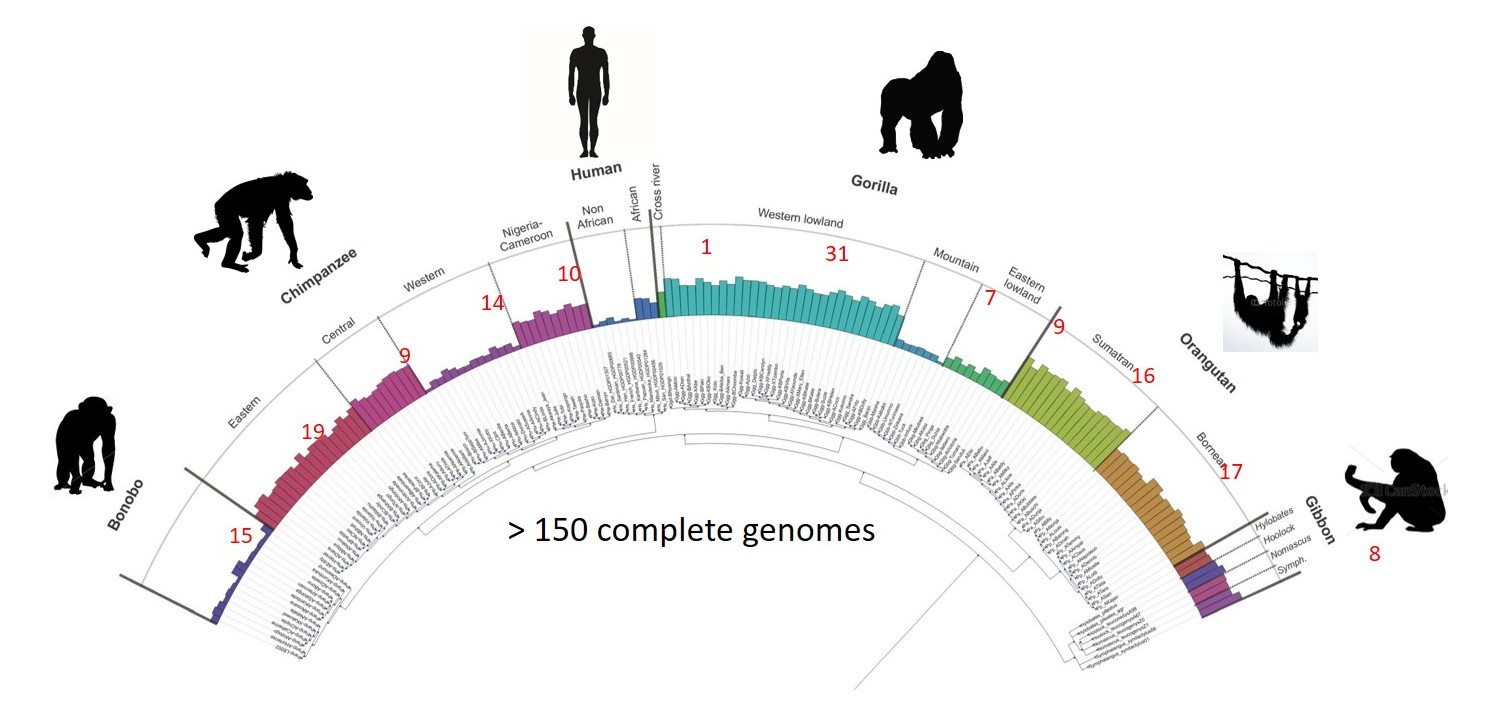
NIH - Comparative Genomics Fact SheetComparative genomics is a field of biological research in which researchers use a variety of tools to compare the complete genome sequences of different species. By carefully comparing characteristics that define various organisms, researchers can pinpoint regions of similarity and difference.*
What goes for physical appearance also goes for genetics, because genetics is related to physical appearance. But it's not like genetics and physical appearance between different life forms can be directly compared. The similarity in DNA between humans and chimpanzees is believed to be between 95% and 98.5%** depending on how it is compared. About 80% of human genes have a match in cows. About 80% of human genes have a match in mice. About 90% of human genes have a matching version in cats.** Cats have 82% of homologous genes with dogs.** But, obviously, cats look much more like dogs than humans. It simply doesn't make much sense to compare apples and oranges.
Similarities are nice, but explaining the differences and how they came about is what it's all about. Like for example orphan genes. For this scientists can't offer any direct evidence, and evolutionists only offer just-so stories based on their belief. Hence metaphysics.

Sanjida O'Connell - Are human beings impossible to ape?Chimpanzees share about 98 percent of our DNA, but bananas share about 50 percent, and we are not 98 percent chimp or 50 percent banana. We are entirely human and unique. We are talking about the difference between using a twig as a tool and using the internet. It is humans that have speech and language, humans that have culture, art, music, science and technology, humans who remember the past, plan for the future, fear death and pay taxes. ... Sometimes, amid all this scientific talk of genetic and cognitive similarity, we can lose sight of the most important facts.*
Evolutionists try to fit the numbers into their belief system by means of metaphysics, but they don't prove anything except for the fact that they, either ignorantly or dishonestly, present their metaphysical theory as a fact to the world.
Common design
Do-While Jones - Chimps Are Like UsClearly human DNA and chimp DNA is very similar. We don't dispute that. ... Scientists can present whatever numbers they want to emphasize whatever they want. Which numbers are the most important is really a matter of opinion. Evolutionists always present the numbers in such a way as to diminish the difference between humans and chimpanzees to make it more plausible that they have a common ancestor. Similarity can either be the result of common ancestry or common design. The 96% (or whatever) similarity alone doesn't prove common ancestry. It might be the result of a designer making two very similar things.*
There are three kinds of lies: Lies, damned lies, and biostatistics. If for example Microsoft Windows 10 were to be 95% similar to Windows 8, it wouldn't show any evolutionary relation between the two, because in reality they were both intelligently designed by intelligent people at Microsoft. Just an example of common design.
Evolutionists believed and taught in schools that 98% of our DNA is useless junk. This was completely wrong, because their prediction was based on their preconceived belief in evolution. Their school textbooks probably still sell this falsehood today because these people are not interested in teaching the right thing or correcting their mistakes. Fact remains that each life form is unique and humans even more so because of their far superior mental capability. Each kind only produces offspring of the same kind. That so many people lose sight of the most important facts of science has to do with blind faith and paradigm paralysis.

The Conversation - Computers can find similarities between paintingsThis is what we might call connoisseurial art history, which is what you might have found in the 19th century. Connoisseurs began to compare works scattered across churches and monasteries, classifying them and trying to discern common authorship. The works were identified for certain similarities of technique or ways of painting, for instance, hands or ears.*
The Physics arXiv Blog - When A Machine Learning Algorithm Studied Fine Art Paintings...The way art experts approach this problem is by comparing artworks according to a number of high-level concepts such as the artist's use of space, texture, form, shape, colour and so on. Experts may also consider the way the artist uses movement in the picture, harmony, variety, balance, contrast, proportion and pattern.*
Similarity can equally result from modifications to a common design.

This picture comes from a webpage called How Porsche Has Kept The 911 Alive Through Evolution.** But of course there is no evolution here at all, not one car ever evolved into another, all models were intelligently designed one after another in time. They are the result of common design. See also post hoc ergo propter hoc.* This goes for everything ever created by intelligent human beings. "Evolution" is a good example of how language and words are used and abused. If "evolution" simply means "change", then basically everything is "evolution", and it doesn't mean anything. Not one real world example can be given for the idea that some complex functional thing, living or not, changes into another, by means of mindless naturalistic processes only, without the intervention of an intelligent agent. Any mentally sane person simply knows that such things don't happen. Similarly to how connoisseurs work in the world of art, the fossil record can be interpreted according to the viewpoint of common design by the same designer.
Fr. Chad Ripperger - The Metaphysics of Evolution TalkOrigins - Evolution and Metaphysics Bertram G. Murray Jr. - Are ecological and evolutionary theories scientific Fred Reed - The Metaphysics of Evolution Steve McIntosh - Evolution's Purpose: Necessary Metaphysics for an Evolutionary Worldview A. N. Wilson - Darwin’s greatness is founded on a myth