Big Bang
The birth of the fine-tuned universe
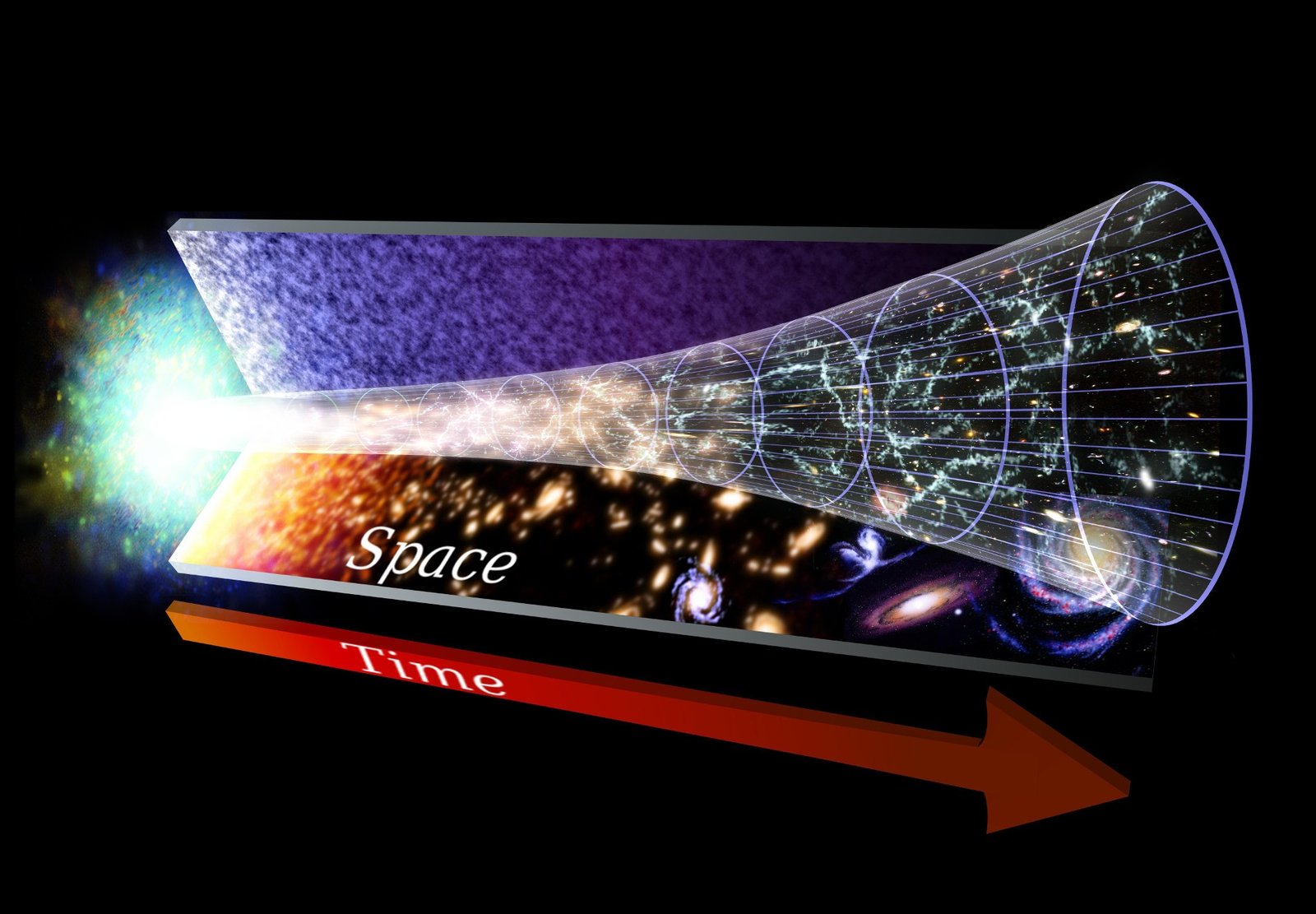
Before the acceptance of the Big Bang theory it was believed that the universe and the earth had always existed, that it was without beginning. It is called the steady-state theory. But the universal laws of thermodynamics already dictated that the universe was evolving towards a state of more entropy with time, which of course indicated that towards the past there must have been a state of lower entropy, reaching a point where it must have had a beginning. In other words, the universe is moving from a state of order towards disorder, ultimately ending in heat death.
In 1929 the Hubble–Lemaître law was presented, which is the observation in physical cosmology that galaxies are moving away from earth at speeds proportional to their distance. In 1965 Cosmic microwave background was discovered which is microwave radiation that fills all space in the observable universe. This confirmed the expansion of the universe. Extrapolating this cosmic expansion backwards in time using the known laws of physics, the models describe an increasingly concentrated cosmos preceded by a singularity, the beginning of everything. These and other discoveries led to the current belief in the Big Bang theory.
So, before the Big Bang theory evolutionists believed in the Steady State theory. This is strange because according to evolution life evolved from inferior to superior states indicating there must have been a beginning of life and ultimately of the universe itself. But the reason for their belief was that it gave them infinite time for their theory of very slow and gradual Darwinian evolution. According to their philosophy, naturalism, they believed that the natural world was all there was. But of course it would be impossible to explain the beginning of the natural world itself by means of naturalism. Cause and effect is a basic tenet of science and reality. Both the coming into existence of the universe and life are dilemmas for naturalism. True science can never explain what happened exactly at the point of the creation of this universe, how it happened, and what was there before it. But we do know that the result is this fine-tuned universe.
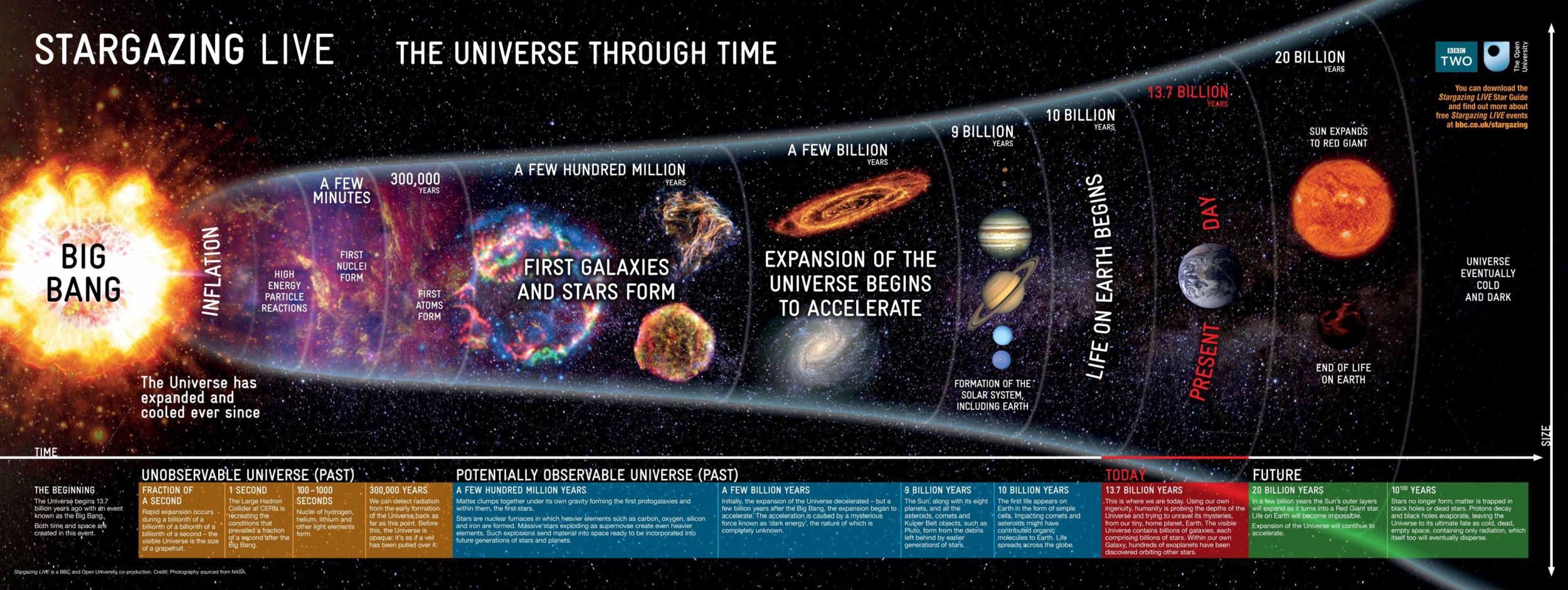
Paul Davies - J.T. Fraser et al: The study of timeIf we extrapolate this prediction to its extreme, we reach a point when all distances have shrunk to zero. ... An intitial cosmological singularity therefore forms a past temporal extremity to the universe. We cannot continue physical reasoning, or even the concept of spacetime, through such an extremity. For this reason, most cosmologists think of the initial singularity as the "beginning" of the universe. On this view, the big bang represents the creation event; the creation not only of all the matter and energy in the universe, but also of spacetime itself.*
The singularity defines the starting point of time and history. This is also where science has reached its absolute limit. It shows that the fine-tuned universe with all its specified complexity theoretically originated from nothing. Atoms are the smallest units of matter and are considered the building blocks of all material. They combine to form molecules, which make up everything around us. Atoms are mostly empty space.**** Science is limited and nobody knows what kind of possibly even smaller particles will be found in the future. The visible world is made of the invisible. All matter consists of particles that are made up of even smaller particles and all of them are attracted to each other by means of invisible forces. Everything seems to resolve into energy and nothingness. But how can nothing turn into everything?
Cosmological argument
Wikipedia - Cosmological argumenta cosmological argument is an argument for the existence of God based upon observational and factual statements concerning the universe (or some general category of its natural contents) typically in the context of causation, change, contingency or finitude.
1. Whatever begins to exist has a cause.
2. The Universe began to exist.
3. Therefore, the Universe has a cause.
Nothing comes from nothing, certainly not by itself. Cause and effect are universal. This is true logical reasoning. This universal reality raises an important question. What caused the fine-tuned universe to pop into existence from nothing? The evolutionary worldview is limited strictly to the unprovable philosophy naturalism and excludes supernaturalism from its pallet of explanations beforehand and without any evidence. But nothing comes from nothing. It is impossible to explain the coming into existence of the fine-tuned universe and the natural world by means of naturalism. Cause and effect, a principle of true science, has simply reached a dead end with naturalism.
Most people will be somewhat familiar with the universal laws of entropy and the law of conservation of energy. If the total amount of energy always remains the same in a closed system, and the quality of energy naturally goes from a higher state to a lower state, then it logically follows that whatever caused the fine-tuned universe to come into existence, it must have been greater than that universe. It must have been incredibly powerful. What would be necessary for the creation of a fine-tuned universe fit for life with all its universal laws, mathematics and specified complexity? Mindless naturalistic processes are out of the question and the only viable option is an intelligent agent. Before the natural world there was the supernatural. The answer is plain and simple, but that answer is not what many people would like to hear or believe. This denial of the obvious has led to some of the most deluded atheistic statements to date...
Atheist delusion
Stephen Hawking - The Grand DesignSpontaneous creation is the reason there is something rather than nothing, why the universe exists, why we exist, it is not necessary to invoke God to light the blue touch paper and set the universe going.*
Stephen Hawking - 'No hay ningún dios. Soy ateo'Before we understand science, it is natural to believe that God created the universe. But now science offers a more convincing explanation, what I meant by ‘we would know the mind of God’ is, we would know everything that God would know, if there were a God, which there isn’t. I’m an atheist.*
This philosophical idiocy of course had its effect on atheists and evolutionists around the world who eagerly parroted these words...
Mike Wall - The Big Bang Didn't Need God to Start Universe, Researchers SayOur universe could have popped into existence 13.7 billion years ago without any divine help whatsoever, researchers say. ... "The Big Bang could've occurred as a result of just the laws of physics being there," ... "With the laws of physics, you can get universes.*
The reality is that science can say absolutely nothing about what caused the creation event of the universe. Which laws of physics were there before the big bang? It's absolutely hilarious to hear so-called "scientists" make incredibly unscientific statements completely based on some kind of incredible faith. In the same article someone said:I don't think you can use science to either prove or disprove the existence of God. What a genius. It is far beyond the limits of science. Hence the use of philosophical statements involving the denial of God. Of course the unprovable philosophy naturalism can never account for anything before the natural world simply because there was no natural world. Anybody who believes that something, let alone everything, can come from nothing by means of nothing is simply deluded.
Roger Penrose said the following about Stephen Hawking's book The Grand Design...
Roger Penrose - debunks M-theory on Christian RadioWhat is referred to as M-theory, isn't even a theory. It's a collection of ideas, hopes, aspirations. ... The book is a bit misleading in that respect.
John Lennox had these wise words...
John Lennox - Nothing creates everything?Nonsense remains nonsense even if spoken by very clever scientists.
Scientists like Stephen Hawking are good examples of people with intelligence and knowledge, but lacking the wisdom to make sense of it all. Knowledge without wisdom.
Cosmic eggs
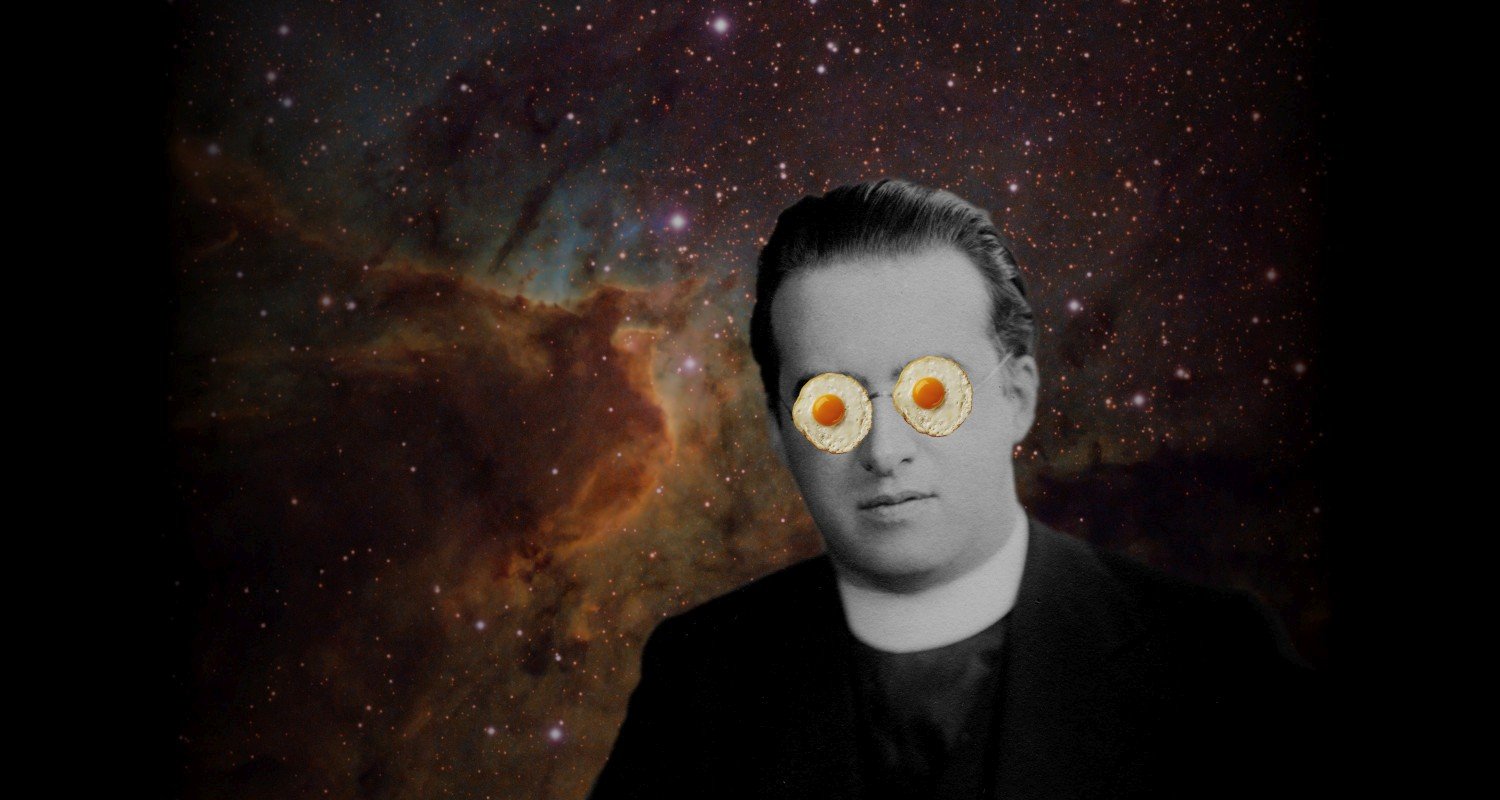
Physics of the Universe - Georges LemaîtreLemaître first voiced his proposal that the universe had expanded from an initial point, which he called the "primeval atom" or "the Cosmic Egg, exploding at the moment of the creation", a theme he developed further in a report published in the journal "Nature" later that year.*
The Cosmic Egg is a mythological motif found in creation myths of many cultures and civilizations. In the Orphic cosmogony, the unaging Chronos produced Aether and Chaos and made in divine Aether a silvery egg, from which everything else appeared. See Arche and The Presocratic Philosophers. Chronos is the god of time which of course also plays a crucial role in the evolutionary belief system. The "golden womb" or "golden egg" is the source of the creation of the Universe or the manifested cosmos in Hindu philosophy. See Hiranyagarbha. Catholic Georges Lemaître proposed the Big Bang theory calling it aCosmic Egg exploding at the moment of the creation.** Catholicism is literally drenched in all kinds of mythical and pagan traditions and beliefs. Easter eggs and bunnies for example.**