Tiktaalik
The fantastic fins to feet fairy tale
Tiktaalik* serves as a prime example of a fantastic evolutionary just-so story. The world of mainstream science presents a fully metaphysical fairy tale as science to the world. According to Sci-News it isthe best-known transitional species between fish and land-dwelling tetrapods.**
Neil Shubin is the evolution crackpot who discovered Tiktaalik. In a video called Introducing Tiktaalik, Your Inner Fish part 1, he saysthere are deep connections among all life forms on this planet.* In Your Inner Fish part 2 he goes on to explain thata human arm resembles the fin of a fish.* In the video at the top of this page he starts by sayingit was definitely the biggest adventure of my life, and a little laterwe dug, hoping to find the fossils we were looking for.In another video called on the Evolutionary Step from Sea to Land,* after explaining how intrigued he was by the fantastic evolutionary just-so story of water-to-land evolution, he saidmy goal was to find new evidence that tells us about how it happened.Berkeley has an article which states thatthe paleontologists who found Tiktaalik went looking for it.** The University of Chicago paid Shubin to make expeditions to the Canadian Arctic in order to find something like this. Obviously, evolutionists desperately hope to find transitional fossils. As William James said:belief will help create the fact.* See also Paradigm Paralysis, Fossil Record, and Metaphysics.
Metaphysics
The University of Chicago says:it looks like a cross between the primitive lobe-finned fish that it lived amongst and the first four-legged animals.** Wikipedia says:many features similar to those of tetrapods.** BBC says:Tiktaalik is considered pivotal because it has many features that look half-way between fish and land animals.** The Guardian says:aquatic features mixed with others more suited to life on land.** NPR says:Tiktaalik bridged the gap between sea living and land living creatures, and played an important evolutionary role on our journey to becoming human.** The Smithsonian says:Tiktaalik roseae had fish-like fins, a flattened skull similar to a crocodile.** Etcetera.
It's all about similarities of this and that. What is missing in all these fantastic fairy tales is the science, because science cannot offer any evidence for a transition from one unique life form into another, even more so because it supposedly happened in the unobservable past. Therefore evolutionists are forced to resort to metaphysics.
Berkeley - What has the head of a crocodile and the gills of a fish?Tiktaalik is technically a fish, complete with scales and gills — but it has the flattened head of a crocodile and unusual fins. Its fins have thin ray bones for paddling like most fishes', but they also have sturdy interior bones that would have allowed Tiktaalik to prop itself up in shallow water and use its limbs for support as most four-legged animals do. Those fins and a suite of other characteristics set Tiktaalik apart as something special; it has a combination of features that show the evolutionary transition between swimming fish and their descendants, the four-legged vertebrates — a clade which includes amphibians, dinosaurs, birds, mammals, and of course, humans.*
After a lot of metaphysical statements they also mention:those fins and a suite of other characteristics set Tiktaalik apart as something special, but they refuse to give the most likely conclusion, namely that this Tiktaalik is just another unique life form unrelated to any other.
Berkeley - What has the head of a crocodile and the gills of a fish?Tiktaalik, for example, had fins with thin ray bones, scales, and gills like most fish. However, it also had the sturdy wrist bones, neck, shoulders, and thick ribs of a four-legged vertebrate. Tiktaalik was specialized for life in shallow water, propping itself up on the bottom and snapping up prey. The adaptations it had for this lifestyle ended up providing the stepping stones for vertebrates to climb onto dry land — but of course, Tiktaalik was not "aiming" to evolve features for land-living. Tiktaalik was simply well-adapted for its own lifestyle and later on, many of these features ended up being co-opted for a new terrestrial lifestyle.*
After more metaphysics they say thatTiktaalik was simply well-adapted for its own lifestyle, which again points to the conclusion that Tiktaalik was first of all a unique life form, fully functional and complete, not in a transition. But the authors dismiss this possibility, and simply assume it evolved. That's because of paradigm paralysis, they only see one possibility.
Zero evolution

Handfish propel themselves by walking on the sea floor rather than swimming. Fossils dated to the early Eocene show they haven't undergone any evolution for 50 million years.** Gobioidei are bottom-dwellers and they also haven't undergone any evolution for at least 50 million years.*
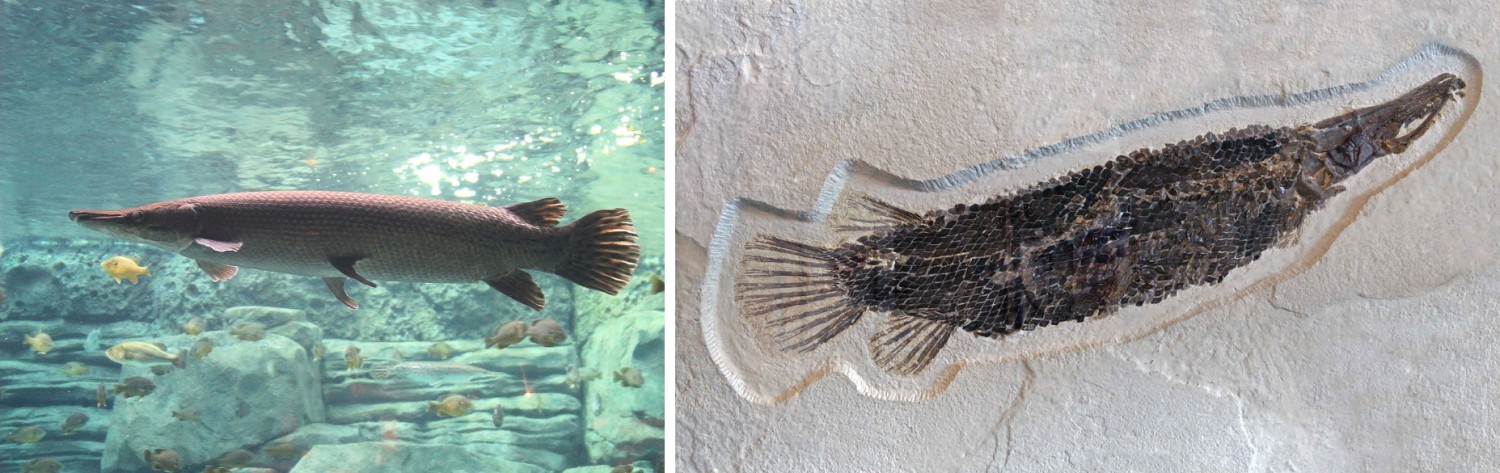
The alligator gar is a primitive ray-finned fish and has an alligator-like appearance and an elongated snout. Fossils from the Eocene show they haven't undergone any evolution for at least 47 million years.* Wikipedia says they are at least 100 million years old and states:Despite being a highly evolved species, alligator gar are often referred to as "primitive fishes" or "living fossils", because they have retained a few morphological characteristics of their earliest ancestors, with seemingly few to no apparent changes.* Other fish have flat heads. All of them are fully functional and unique life forms.
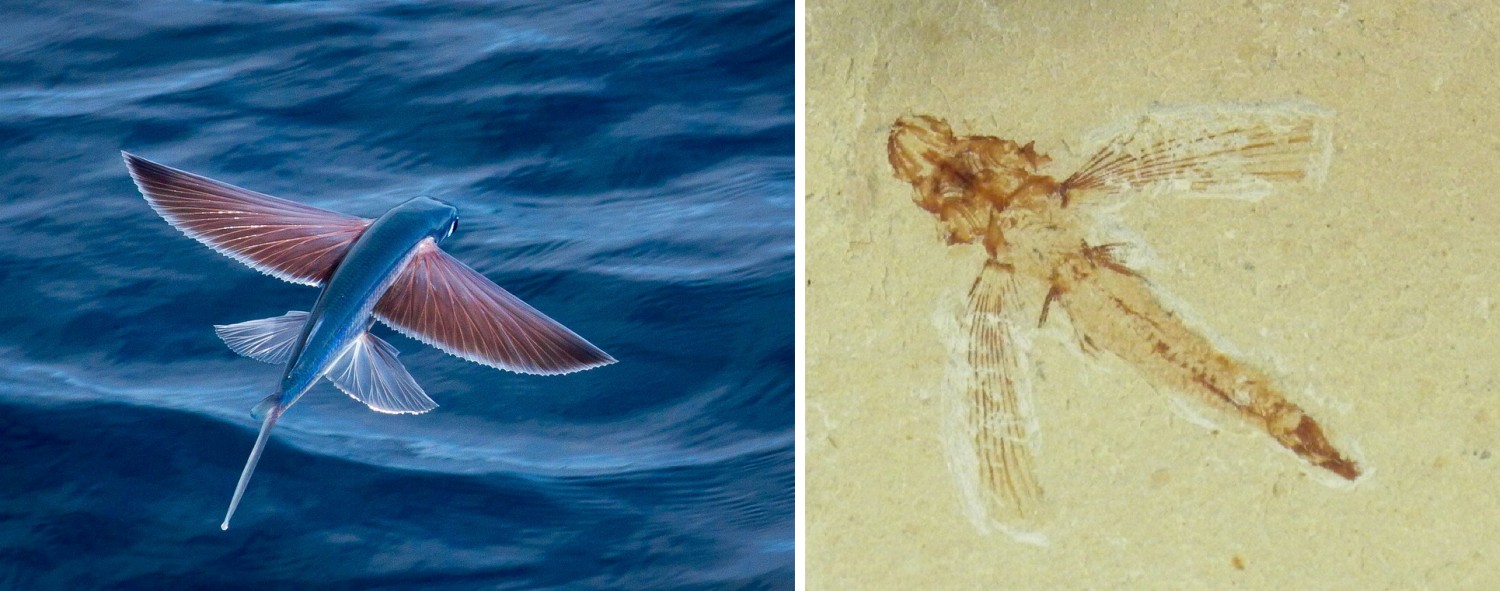
Flying fish can make powerful, self-propelled leaps out of water into air, where their long, wing-like fins enable gliding flight for considerable distances above the water's surface. Another fully functional and unique animal. Their fossils from the Middle Cretaceous Cenomanian Stage show they haven't undergone any evolution for at least 95 million years.** Etcetera. Evolutionists systematically leave out the most logical and scientific explanation, namely that newly found fossils are unique life forms unrelated to any other and have never undergone macroevolution, because none of them evolved any new features not already present in their oldest known fossils, and any supposed link between these unique life forms is completely based on metaphysics.